Journal · 9 min read
How to use AI without losing your ability to think without it.
Cognitive outsourcing is real, and it does not require laziness. Here is how to let AI do the heavy lifting while keeping the reasoning yours.
There is a version of the AI conversation that gets quietly skipped in most teams, the one where someone asks what happens to the person doing the work when the work itself changes shape. Not in the abstract sense of "will AI take my job," but in the more immediate, personal sense: if I outsource the reasoning to AI long enough, what happens to my ability to reason without it?
The concern is not paranoia. It is a version of something that has happened before, with every major cognitive tool that humans have built. When calculators became standard in classrooms, teachers worried that students would lose the ability to do arithmetic in their heads, and they were partially right: mental arithmetic did atrophy for many people, in ways that were real and measurable. When GPS became ubiquitous, researchers documented the gradual reduction of spatial reasoning and mental map-building in people who stopped navigating without it. When spell-check became universal, the relationship between writers and their own sense of correct spelling shifted in ways that are still discussed. When search engines made every fact a few keystrokes away, some researchers raised concerns that the reduction in memory load would cost us something in the depth of our knowledge networks. And when photography emerged as a documentation tool, portrait painters feared the discipline would lose its necessity.
Each of those shifts followed roughly the same arc: initial alarm, slow adaptation, and then a new normal in which the old skill partially atrophied, partially transformed, and the world continued. We are somewhere near the beginning of that arc with AI, which means the alarm is fresh and the adaptation is still forming. That is a useful place to be, if you pay attention to what the alarm is actually pointing at.
The question is not whether to use AI. That debate is largely settled for most people doing serious work. The question is what posture you take toward it while you do.
What cognitive outsourcing actually looks like.
Cognitive outsourcing is the gradual transfer of reasoning work to an external system, without retaining the logic that went into it, which leaves you unable to explain, defend, or build meaningfully on the output. The key phrase is "without retaining the logic." The problem is not that AI does the work. It is that if you treat AI output as a final answer rather than a starting point, you stop developing the judgment that would let you evaluate whether the answer is any good.
The clearest version of this is the kid whose parent did the homework. The work is done. The grade is fine. But at school the next day, when the teacher asks a follow-up question, there is nothing there. The student does not have the reasoning, only the result. This is precisely the risk with AI: that you accumulate a portfolio of work produced with AI, or rather that AI produced for you, and one day in a meeting someone asks you to explain the thinking behind one of those pieces, and you cannot.
This does not require negligence or laziness. It can happen to careful, diligent people who use AI exactly as intended, if they use it purely as an output machine rather than as a thinking partner they remain actively engaged with.
Why every technology shift feels like this, and what we can learn from it.
The calculator comparison is worth taking seriously because it illustrates both the fear and the resolution. Mental arithmetic did partially atrophy for many people when calculators became standard, and that is real. But what it freed up in terms of cognitive energy for higher-order mathematical thinking turned out to be more valuable than what it cost. The skill that mattered shifted from computation to problem formulation: knowing which calculation to run and how to interpret the result, rather than being the person who ran it manually.
GPS made some spatial skills atrophy while making navigation accessible to vastly more people. The skill that shifted was not navigation but rather the type of spatial reasoning that involves building a persistent mental model of your environment over time. Some of that is genuinely reduced in heavy GPS users. Whether that tradeoff is worth it depends on what you do and how much that particular skill matters to you.
The pattern across all of these shifts is the same. The cognitive load does not disappear; it moves. The question is whether you are intentional about where it moves to. With AI, the work that AI automates is real, but the work that remains is the work of judgment: knowing what to ask, how to evaluate the answer, when to push back, and how to build on the output in ways that move the work forward. That is a different kind of thinking, not less thinking, but it requires you to stay in an engaged relationship with what AI produces rather than a passive one.
The VP model: how to stay in the reasoning while AI does the work.
The most useful frame I have found for getting this right comes from how organisations handle knowledge and execution across levels. A VP of Product is not actively building features day to day; the senior PMs, engineers, and designers are doing that work. But the VP does not simply wait for quarterly readouts and approve things at arm's length. They have regular syncs with the senior PM. They get a breakdown of what was executed, why the decisions were made, what trade-offs were weighed, and what the team is uncertain about. They stay in the reasoning even when they are not doing the execution. That distinction is what lets them make good strategic calls and spot problems the team is too close to see.
This is the posture that works with AI. Let AI do the execution: the draft, the prototype, the analysis, the first pass of the brief. But actively get the breakdown. Ask AI to explain what it did and why. Ask it what it assumed. Ask it what it weighed up. Ask it where it is less certain. Keep the reasoning in your own head, not just in the output. Top performers working with AI tend to do this almost instinctively; they use AI at pace, but they are constantly asking it to show its work, and they are building their own understanding alongside the output rather than downstream of it.
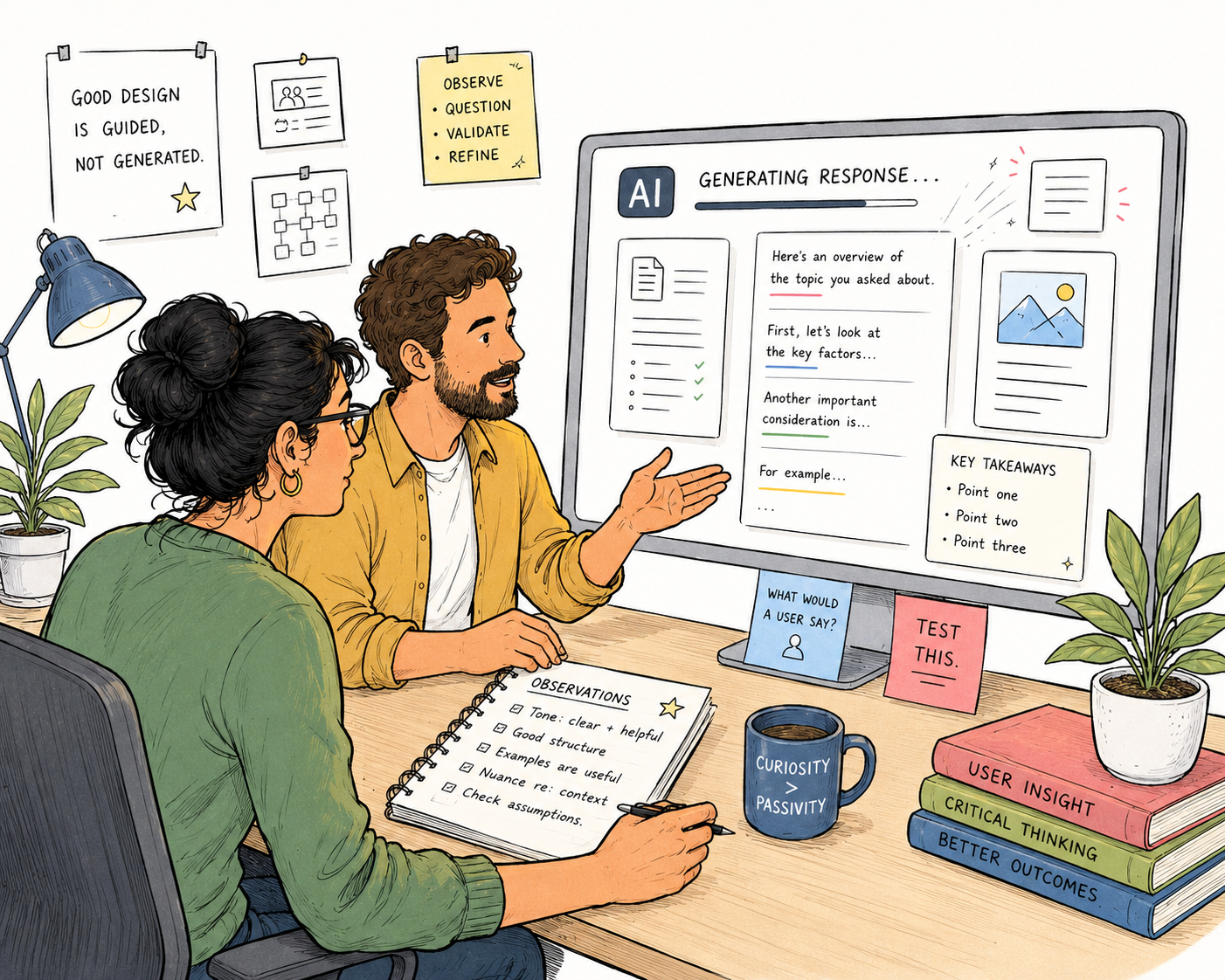
Six ways to stay cognitively engaged while AI does the heavy lifting.
None of these require you to slow down or use AI less. They are habits of engagement that run alongside your existing workflow.
Ask AI to explain its reasoning, then challenge it. After any significant AI output, ask it to walk you through the thinking behind the main decisions. Then push back on at least one thing you are uncertain about. This keeps you in an evaluative relationship with the output rather than a receptive one, and it also tends to surface assumptions worth examining.
Write your own rough answer first. Before prompting AI on a complex question or design problem, spend five minutes writing your own answer, even just a few sentences. You are not trying to be right; you are priming your own thinking so that when you see AI's output, you are comparing rather than simply absorbing.
Do at least one prompt-free session a week. An hour of working through a problem on your own, without AI, maintains the cognitive muscles most at risk of atrophy. It also regularly reminds you which parts of your thinking are genuinely yours versus which parts you have effectively delegated.
Reconstruct AI's frameworks from memory. When AI gives you a structured framework, a decision matrix, or a set of principles, read it carefully, close the window, and reconstruct it from memory. What you cannot reconstruct is what you do not yet own. This is especially useful for frameworks you intend to present to stakeholders, because "can you walk me through the thinking on this?" is a question you should always be able to answer without referring back.
Ask AI what it does not know. Specifically ask where its analysis is weakest, what it assumed without being sure, and what a reasonable alternative interpretation would be. The gaps in AI's reasoning are as important as the conclusions, and you are better positioned to fill those gaps when you have actively looked for them.
Teach it back. After working through something with AI, explain the result to someone else, or write a brief summary of what you did and why. The act of articulating the reasoning to another person forces you to verify that you actually understood it and did not just receive it.
One counterargument, resolved.
The counterargument is that thinking alongside AI still counts as thinking, and that the concern about cognitive outsourcing is overstated because you are still making the decisions about what to ask and how to evaluate the output. This is partially right. The meta-cognitive work of deciding what to prompt and judging what comes back is genuine thinking, and it is not nothing.
But it is not sufficient on its own for two reasons. First, the judgment required to evaluate AI output well depends on a baseline of domain knowledge that needs to be actively maintained; if you stop working problems through from first principles, the baseline erodes and the judgment goes with it. Second, the ability to explain and defend your work to stakeholders, to push back when AI gets something wrong, and to notice when an output is subtly off requires you to have thought through the problem yourself at some point, not just reviewed someone else's answer to it.
The goal is not to distrust AI or to underuse it. It is to stay in a position where you could think without it, even when you choose not to.
FAQ
Frequently asked questions
- What is cognitive outsourcing?
- Cognitive outsourcing is the gradual transfer of reasoning work to an external system (in this case AI) without retaining the logic that went into it. The result is that you can produce output with AI that you cannot explain or defend without it. The risk is not using AI; it is using it as a pure output machine rather than a thinking partner you remain actively engaged with.
- Will AI cause cognitive decline?
- Some specific skills will partially atrophy, just as GPS use reduced some spatial reasoning and calculators reduced mental arithmetic for frequent users. The question is not whether atrophy happens but whether you are intentional about the trade-off. The skills most at risk are the ones you stop practising, which is why deliberate prompt-free work still matters.
- How do top performers use AI without losing their edge?
- They stay in the reasoning while AI does the execution. They ask AI to explain its thinking, push back on decisions they are uncertain about, and treat AI output as a starting point for judgment rather than an end point. They use AI at pace, but they are building their own understanding alongside the output, not downstream of it.
- How do I know if I am cognitively outsourcing too much?
- A reliable test: can you explain the reasoning behind your last three significant AI-assisted outputs to a sceptical colleague without referring back to the AI? If not, you have outsourced more than you have retained. The homework-parent pattern shows up the moment someone asks a follow-up question you cannot answer.
- Do I need to use AI less to avoid cognitive outsourcing?
- Not necessarily. The habit of engagement matters more than frequency of use. Asking AI to show its work, writing your own answer before prompting, and doing periodic prompt-free sessions all preserve cognitive engagement without requiring you to slow down or use AI less often.
Stay in touch
Want to keep talking?
I’m on LinkedIn. Connect, send questions, or just lurk. All welcome.